
The set of InfoClouds hasn’t had a written overview until now. The four InfoClouds relate to the Model of Attraction, which is the essential foundation for many models and thinking I have used from 2002 to present. I’ve done over 400 presentations, workshops, lectures, and internal organization training. I have mentioned and written about the Personal InfoCloud, from the perspective that people know it. Similarly, the Local InfoCloud has been used as a foundation for a lot of location-based information systems, as well as organizational information and social interaction workflow framings, and much more using it as a foundation for mapping internal and known resources. The other two InfoClouds I don’t know that I’ve brought them up through use or written much about them to set their foundations.
A Brief Touch on the Model of Attraction
To set the understanding of the four InfoClouds a quick look at where they came from. The start of the InfoClouds came from very early discussions and explaining the Model of Attraction – First Draft :: vanderwal.net from 2002. The focus is a person not only attracts information to their screens and devices, but “Users have a rough cloud of information following them that has a magnetic attraction toward them and their interests.”
From this initial and often repeated person-focused “rough cloud of information”, drew questions about the cloud and quickly realized there are other “clouds”. In short order mapping out the flows and the systems four distinct clouds were apparent. Within a few months of the initiation of the Model of Attraction the four InfoClouds were part of he explanations and presentations.
The Four InfoClouds
These four InfoClouds have distinct properties and roles and are helpful for understanding how people find and interact with information. These four properties matter for understanding how people access, retain, retrieve, think about, and have a desire to use the sources and information.
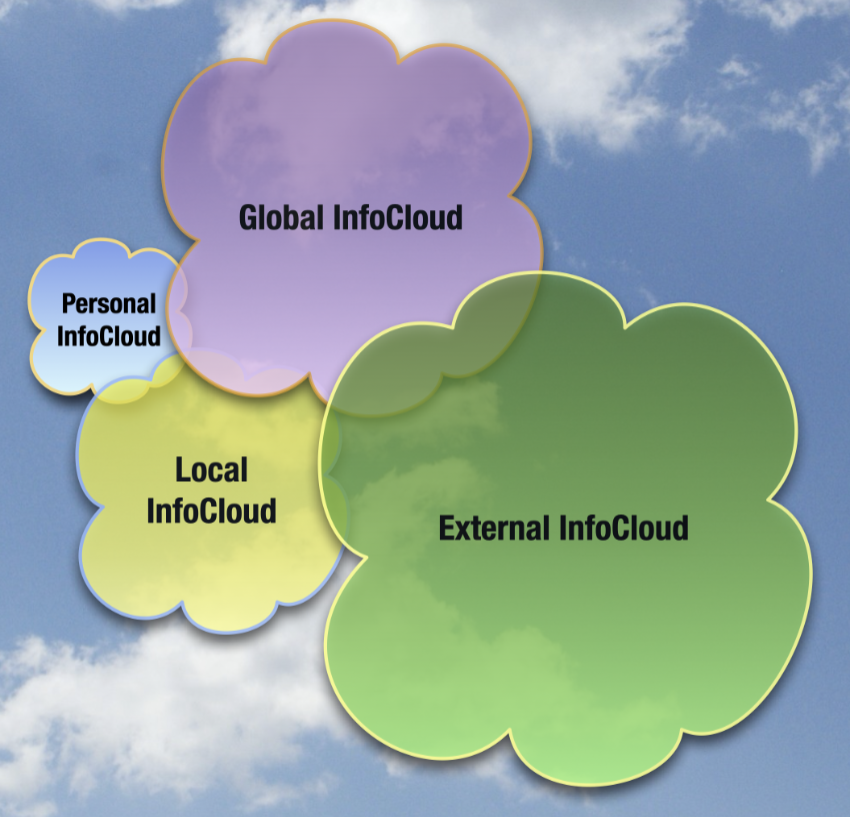
As seen in the image the Personal InfoCloud interconnects and interacts with the Local InfoCloud and Global InfoCloud.
Personal InfoCloud
The Personal InfoCloud is our personal collection of our information and objects that are created and/or found. But it also includes our connections to people and organizations, our interests and potential interests. It also includes our recent and upcoming events. It keeps all of what is relevant within a close reach from our device that is with us and/or near us. It isn’t a specific device that is important, but the access to our information from our devices.
The key properties for the Personal InfoCloud are that it is centered on the person, it is available to access as needed, it is organized for ourselves in our understanding and what works best for us. The Personal InfoCloud is task, action, and context aware.
From the Model of Attraction perspective the Personal InfoCloud is what we have attracted to ourselves through search or other queries and requests and want to keep it attracted to ourselves. It is that rough cloud of information that comes with us with easy access when we want it and need it.
Local InfoCloud
The Local InfoCloud are the resources we are familiar with, but we do not own them, control them, nor organize them, but we know where and how to access them. The Local InfoCloud can be organizations, services, and/or people. They don’t have to be physically local, but can be, but they are near in thought.
I have a more full write-up here at: Exposing the Local InfoCloud – Personal InfoCloud. This lays out the breadth of possible elements in a Local InfoCloud. Understanding your or your group’s Local InfoCloud of resources (in a group each person’s Local InfoCloud is very likely going to be different, as everybody has multiple contexts they live in and with). A good exercise is to map out Local InfoClouds for people and groups to understand the variance in resources, based on contexts.
Global InfoCloud
When we don’t have information close in our Personal InfoCloud nor Local InfoCloud from a known resource we turn to the Global InfoCloud, which are resources we have access to on the Internet.
The attributes for the Global InfoCloud are: There is access to the information from most anywhere; It isn’t organized by the by the user; The user doesn’t control it; and structures, the organization, and terms may not be familiar.
External InfoCloud
The last InfoCloud is the External InfoCloud which are resources that the user doesn’t have access to. The lack of access may be due to: It is behind a firewall; It is location-based access restricted; It is paywall or membership restricted access; The information is in encrypted; The information is in another language; and/or the information is and knowledge is difficult to share.
The InfoCloud Relationship to the Person
These InfoClouds all have a purpose and are relevant for understanding how people act and interact with devices and services. One of the key understandings is the Personal InfoCloud and the reality of a person’s perspective on what is in their Personal InfoCloud. What is in there, whether created by the person or others and found is considered, “my information” by most people. Once people find information from Local and Global InfoClouds and pull it to their Personal InfoCloud they most often structure and organize the information for easy access for themselves. As people get occasional access to things in the External InfoCloud they often work with it as if it is from a Global InfoCloud, with the addition of working to get continued access to that resource to make it a Local InfoCloud resource.
Leave a Reply